


Use of Bile Salts in Poultry Nutrition: A Scientific and Practical Approach
Introduction:
The poultry industry is under constant pressure to enhance feed efficiency, support rapid growth, and maximize profitability while maintaining animal health and sustainability. In this context, feed additives that improve nutrient utilization have become increasingly valuable. Among these, bile salts have emerged as a potent tool to improve fat digestion, energy utilization, and overall bird performance. Though bile salts are naturally produced in the liver, their supplementation in poultry diets—particularly in broiler chicks and birds consuming high-fat or energy-dense diets—has demonstrated notable benefits.

Freelance consultant,
Bangalore India
This article provides an in-depth review of the science, mechanisms, applications, and experimental outcomes associated with the use of bile salts in poultry feed.
What Are Bile Salts:
Bile salts are amphipathic molecules synthesized from cholesterol in the liver and secreted into the duodenum through the bile duct. These compounds serve as natural emulsifiers, enabling the breakdown of dietary fats into smaller particles for better enzymatic digestion. The most common bile salts include cholic acid and chenodeoxycholic acid, which are conjugated with amino acids like glycine or taurine. In poultry, especially in the early post-hatch period, the bile system is not fully developed.

Kemin Industries South Asia
Limited bile production may lead to suboptimal lipid digestion and poor utilization of energy, especially when birds are fed high-fat diets. Supplementing diets with exogenous bile salts compensates for this limitation, promoting efficient digestion and nutrient uptake.
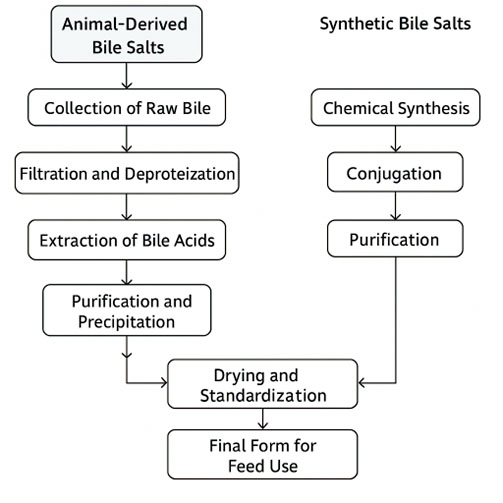
Manufacturing/sourcing of Bile Salts:
Bile salts used in animal nutrition are typically manufactured through a multi-step process involving extraction, purification, and sometimes synthesis. Here’s a breakdown of how bile salts are manufactured, particularly for use in poultry feed.
 Mechanism of Action in Poultry Digestion:
The primary function of bile salts is to emulsify lipids in the digestive tract. Dietary fats are hydrophobic and tend to aggregate in the aqueous environment of the intestine. Bile salts convert these large fat globules into micelles, thereby increasing the surface area for the action of pancreatic lipase, the enzyme responsible for breaking down triglycerides into monoglycerides and free fatty acids.
Additional Benefits:
- Facilitate absorption of fat-soluble vitamins (A, D, E, and K)
- Improve cholesterol metabolism
- Stabilize gut microflora and improve gut health
Applications and Benefits in Poultry Nutrition:
1. Enhanced Lipid Digestibility
The most immediate impact of bile salt supplementation is the improvement in fat digestibility, particularly in diets using:
- Saturated fats (e.g., tallow, palm oil)
- Economic but less digestible fat sources
Improved digestibility leads to higher energy availability for growth and metabolic functions.
2. Support for Young Chicks
Newly hatched chicks have immature livers and underdeveloped bile secretion. Bile salts in the starter diet:
- Compensation for poor endogenous production
- Improve early feed efficiency
- Support gut development and health
3. Improved Growth Performance
Several studies have shown that exogenous bile salts lead to:
- Increased body weight gain
- Reduced feed conversion ratio (FCR)
- Enhanced apparent metabolizable energy (AME)
4. Cost Efficiency
By improving the digestibility of cheaper fats, bile salts enable producers to reduce reliance on high-cost vegetable oils. This results in:
- Lower feed costs
- Optimized feed formulation
- Improved profit margins
Performance Trials and Scientific Evidence:
Trial 1: Zhang et al. (2011)
Objective: Compare effects of bile salt supplementation on broilers fed tallow vs. soybean oil diets.
- Design: 360 broilers; six treatment groups; bile salts at 0.1%
- Results:
- Tallow + bile salts → +9.2% body weight gain, +8.5% FCR improvement
- Higher fat digestibility with bile salts
Reference: Zhang, B., Haitao, L., & Chi, Y. (2011). Poultry Science, 90(12), 2701–2709.
Trial 2: Xie et al. (2020)
Objective: Evaluate bile salt effects on broiler starter performance
- Design: 400 chicks, bile salts at 0.05% and 0.1% (first 21 days)
- Results:
- +6.7% growth, lower FCR
- +5.2% increase in AME
- Lower serum triglycerides
Reference: Xie, M., Hou, S. S., Huang, W., & Fan, H. P. (2020). Animal Feed Science and Technology, 267, 114542.
Trial 3: Khan et al. (2017)
Objective: Use of bile salts with palm oil-based diets in broilers
- Design: 240 broilers, bile salts at 0.1%
- Results:
- Fat digestibility: from 72.3% to 81.6%
- Improved vitamin E absorption
- Increased daily gain
Reference: Khan, R. U., et al. (2017). Livestock Science, 197, 92–97.
Summary of Trial Results:

Practical Guidelines for Use:
Inclusion Rates
- Typical dose: 0.05–0.1% of the diet
- High doses may not yield proportional benefits and could influence gut microbiota
Compatibility
- Most effective when used with low-digestibility fat sources
- Can be combined with lipase enzymes for synergistic effects
Sources
- Commercially available bile salts are typically derived from bovine or porcine origins
- Plant-based or synthetic alternatives are under research for use in vegetarian or religiously restricted feed systems
Limitations and Considerations:
- Cost vs. Benefit: The cost of bile salts must be justified by performance gains
- Quality of Product: Purity and origin matter—contaminants or low-grade sources may reduce efficacy
- Bird Age and Diet Type: Younger birds and fat-rich diets show the most pronounced benefits
Conclusion:
Bile salts have proven to be a valuable feed additive in poultry nutrition, particularly when aiming to enhance lipid digestion, optimize energy utilization, and support early-stage chick development. Supported by substantial trial data, their use enables more economical feeding strategies and contributes to improved growth performance and feed efficiency. As the industry moves toward precision nutrition, incorporating additives like bile salts—especially in targeted phases of production, can play a pivotal role in achieving both economic and sustainability goals.
Authors:
Dr Pattath Damodar, Freelance consultant, Bangalore India
Dr Sushant Labh, Kemin Industries South Asia
Previous article by Dr Sushant Labh:
Recent Advances in Calcium and Phosphorus Nutrition for Broilers (An Indian Perspective)