
The 2021 Global Feed Survey representing 142 Countries, was conducted by Alltech – both quantitatively and qualitatively and the analysis evaluates country, regional and global trends.

2021 Global Feed Survey Excerpts :

GLOBAL FEED PRODUCTION: 1% growth globally, 1,187.7 million metric tons produced.

The year 2020 was challenging for many industries and the feed, agriculture and food industries were no exception. The survey showed that, regionally, COVID-19 had varying effects. Some regions, such as Africa, cited more challenges than others, and in many cases, this was a country-by-country determination. The rise of e-commerce was seen around the world and is expected to be ongoing for food purchasing in the future.
Feed prices greatly affected producers. Additional challenges to these prices included government regulations of more sustainable practices, such as lowered nitrogen use and the reduction or elimination of antibiotics.

FEED MILLS: 3% reduction in Feed Mills growth.

It is estimated that nearly 1,000 feed mills closed in the last year. Many other countries fluctuated between an increasing and decreasing number of mills open.

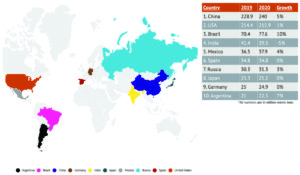
TOP TEN COUNTRIES

The top 10 countries are responsible for 63% of global feed production. They have average feed costs around 9% less than the global average and have an average growth of 2%.


LAYERS:

Poultry meat and eggs are generally considered universal foods. Some industry challenges arose from the widespread shutting down of restaurants. Disease, such as avian influenza, was also a concern and remained a challenge for many in the business. However, offsetting any declines in feed production due to these challenges was an increased interest in eggs as an inexpensive protein, particularly for those in economically suppressed areas.


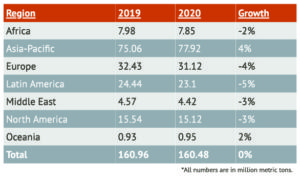
Globally, layer feed production remained flat. Disease, such as avian influenza, has affected Europe, especially in the end of latter part of the year.

There is a greater movement toward antibiotic-free (ABF) feed production especially in parts of Europe and Latin America. In some countries, such as Italy, the regulation of ABF is done through the government. Other countries, such as the U.K. and Brazil, are seeing producers adopt practices to comply with consumer demands.

BROILERS:

The changes in broiler feed production were, in some cases, a direct result of COVID-19 and its effect on the restaurant and food-service businesses. Although this was generally considered a short-term effect, there were instances of permanent change. Disease, such as avian influenza, also affected the industry. Overall, however, the industry fared well due to the short growth cycle and the easy adaptability of production methods.

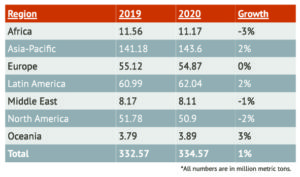
Globally, broiler feed increased by 1%. Feed production growth was led by Asia-Pacific —
especially China, but also Bangladesh and Vietnam — as well as Latin America, including Brazil, Venezuela and Chile.

Some declines in broiler feed were seen initially as the result of the closing of restaurants and hotels, although this was later offset by increased at-home cooking, particularly as this meat is considered low-cost and easy to cook.

On antibiotic free broiler meat, there were increased investments in some countries, such as Brazil. Others are adopting the practice of ABF to meet consumer demand.

PIGS: Pig feed increased globally by 1% (286.36 MMT in 2020 as compared to 282.58 MMT in 2019).

DAIRY: Globally, dairy feed production remained relatively flat (128.81 MMT in 2020, 128.77 MMT in 2019).

AQUACULTURE: The overall global growth of 3% was the strongest among all of the primary
protein species (49.39 MMT in 2020 as compared to 48.04 MMT in 2019).

PETS: The pet industry was one of the few industries that reaped benefits from COVID-19 and the related lockdowns, with pet adoption rates soaring. (29.33 MMT in 2020 as compared to 27.09 MMT in 2019).

Source : 

Broiler performance is graded in India by comparing Average body weight, Average day gain, FCR, CFCRs, Livability and EEF/PPI (European Efficiency Factor or Poultry Performance Index). 9 out of 10 Poultry Production companies in India work on performance optimization. They formulate very high-density feed so that they can grow birds to be marketed early say at 32 to 35 days with very low FCRs (some getting even below 1.4). They celebrate these achievements and proudly share this performance in forum and medias.
There are also some poultry producers who work on Profit optimization. Their performance is average to low, but they make good profits silently. They don’t pat their backs for good performance and achievement but are growing month on month in their business.

Impact of 1-point FCR difference:

Let’s start by calculating what is the impact of 1-point FCR. The cost of 1-point FCR depends upon the cost at which feed has been made and reference FCR. For e.g., the same 1-point FCR cost will be higher for feed calculated at ₹30/kg than at ₹29/kg. Similarly cost of 1-point FCR will be higher when reference FCR is 1.5 than it is 1.6 or above.

Equations used to calculate are:

Current FCR * Feed cost per kg = Feed cost per live kg
Feed cost per live kg/Projected FCR = Future feed Value
Future feed value – Original feed cost = Cost of 1-Point FCR in ₹

(Figure 1 – Cost of 1-Point FCR in different field perspectives)

In the above table, cost impact of 1-Point FCR at different feed cost and standard reference FCR is mentioned in ₹. From the table is can be made out that if feed cost is ₹30/kg and someone getting 1.60 FCR for his farm cost of 1-Point FCR is ₹0.19 or 19 paisa in terms of Feed costing.(Figure 1 – Cost of 1-Point FCR in different field perspectives)

Production cost and margin impact:

Similar mathematical modeling can be applied for calculation of production cost as well as profit optimization also. Assuming current chicks’ price ₹45/unit (its high but this is the prevailing rate), management cost ₹4/bird and standard liquidation/selling weight 2.2kg/bird production cost has been calculated at various feed rates.

(Figure 2 – Broiler Production cost/kg in different field perspectives)

One thing which can be clearly made out from the table is, for profit optimization only better (lower) FCR is not important but also formulation cost. For someone formulating very high-density feed at ₹32/kg and getting 1.50 FCR will have production cost of ₹70.27 whereas moderate density feed formulated at ₹28/kg and getting FCR 1.70 will have production cost of ₹69.87 and will run with more profits.

Some field veterinarians may disagree to this calculation as they have observed more mortality and field challenges with birds growing slowly. They complain of issues related to gut health, respiratory tract after 20 days and feel good when birds are liquidated at 33-35 days. But with good gut health and respiratory infection prevention plan in place, disease challenges can be easily managed. Also, production is a big stress in birds, slow growing birds are less prone to immunosuppression and metabolic disorders. Lower Average Day Gain doesn’t always mean higher mortality which can also be corelated to broiler grown on welfare norms and free range in western world.

Interpretation and commercial use:

  1. Better performance may not always be better profits, the correct approach must be followed for profit optimization.
  2. Integrators with limited farming and very stringent farm selection can go with performance optimization approach.
  3. Integrators with operations across multiple states and looking for expansions should always work on the profit optimization model. The density of feed should be medium to low so that the impact of 1-Point FCR is also less.
  4. In pockets with very high density of poultry population, the performance of same feed across farms depending upon management is 20-30 Points FCR. For these areas profit optimization concept works the best.(Figure 3 –Line graph demonstrating FCR, PC and Feed Cost)
  5. Additives pertaining to gut health, disease needs not to be compromised while formulating feeds at a lower cost. Good health monitoring and management practices are always helpful in keeping diseases at bay.
  6. Lower to medium density feed can be formulated at a lower cost but the things to keep in mind is the percentage inclusion of alternate ingredients. Minimizing the variation in raw ingredients through good quality control process and use of suitable enzymes are giving edge to the poultry producers following this approach in India.
  7. Top 2 out of 3 Indian Integrators are successfully following profit optimization approach and they are satisfied with average performance.

For references, questions and feedback write to Novel Life Consultants, Bangalore. Email id is novellife.bangalore@gmail.com and contact no Landline 080-41326221 Mob- 9611337444)


(This article is a work of Novel Life Consultant and is for public information purpose only. This has been written to share knowledge on poultry nutrition and is not a legal information or statement. Reference to any specific product or entity doesn’t constitute an endorsement or recommendation by the company. The views expressed by the writer are their own and their appearance does not imply an endorsement of them or any entity they represent.)

On 1 Feb 2021, EW Nutrition completed the acquisition of the Feed Quality and Pigments business from Novus International, Inc. Under the terms of the agreement, EW Nutrition becomes the owner of world-renowned brands such as Santoquin® feed preservative, SURF●ACE®, a feed mill processing aid, and feed ingredient Agrado®. The acquisition also gives EW Nutrition ownership of a state-of-the-art production facility in Constantí, Spain.

“This transaction will bring additional value to our customers, further reinforcing EW Nutrition’s global market position, and increasing its product portfolio and geographical reach,” says Michael Gerrits, Managing Director of EW Nutrition. “The products acquired will further support EW Nutrition’s mission to mitigate the impact of antimicrobial resistance by providing comprehensive animal nutrition solutions.”

Dan Meagher, President and CEO of Novus International, Inc., explained that the sale is part of Novus’s Project Destiny, a multi-year plan to focus the company’s resources on core platforms and emerging technologies, with a focus on gut health.

“We are pleased to have found a committed owner for these platforms so that they may continue bringing value to the industry,” said Meagher. “This event is a significant milestone in our Project Destiny journey. Now that our Feed Quality and Pigments platforms are in good hands with EW Nutrition, we are excited to focus our energies on developing new, innovative technologies into meaningful nutrition solutions for our customers.”

A robust services agreement between the companies is governing critical activities to ensure customers are supported through the transition. The range of products is immediately available to customers.

EW Nutrition is a global animal nutrition company that offers integrators, feed producers, and self-mixing farmers comprehensive, customer-focused solutions for gut health management, antibiotic reduction, young animal nutrition, toxin risk management and more. For details, visit https://ew-nutrition.com

Proteon Pharmaceuticals India invites you to join the FREE webinar on – Natural guard against E. coli – Ensure a better future of your farm.

Panelist – Dr. Sudheer Rukadikar and Ms. Justyna Andrysiak
Date: 9th February 2021
Time: 15:30 hrs to 16:30 hrs
Place: Zoom Meeting

Click here to register Free.

The webinar will cover:

  • Introduction to E. coli
  • How E. coli affects health of flocks
  • Farmers concern on E. coli
  • Prevention and control of E. coli
  • How bacteriophages act as natural guard against E. coli

Proteon Pharmaceuticals S.A., headquartered in Poland, is a leader in bacteriophage (phage) technology for livestock farming. It is the first company to develop precision bacteriophage based feed additives to combat bacterial infections in poultry.

IB ABIS Exports (India) Pvt. Ltd. launches its hi-tech Poultry Feed Plant in Muzaffarpur, Bihar

ABIS Exports (India) Pvt. Ltd., in its endeavor to support Bihar State achieve self-reliance, inaugurated its new State-of-the-art 1200 MT poultry feed plant at Bela Phase 2 Industrial Area, BIADA, Muzaffarpur on 9th Jan 2021. The Chief Guest of the inaugural function was Shree Giriraj Singh Ji, Hon’ble Minister of Animal Husbandry, Fisheries & Dairying, GOI and special invitee was Smt. Renu Devi Ji, Honorable Deputy Chief Minister, Bihar State.

Mr. Bahadur Ali, Founder & Managing Director, IB Group, Sh. Sultan Ali, Founder & Chairman and Mr. Gulrej Alam, Director have emerged as a role model for the Industrialists of Bihar.

The new feed plant is spread over an area of about 5 acres and the first phase of manufacturing poultry feed has already begun. Manufacturing livestock feed and fish feed is also proposed in future.

While Interacting with the press, Mr. Bahadur Ali, Founder & Managing Director, IB Group shared that the idea to setup feed plant in Bihar came up during his interaction with Shree Giriraj Singh Ji, Central Minister. In 2018, while the Hon’ble Minister was touring India and had visited Rajnandgaon, Chattisgarh, it was Shree Giriraj Singh Ji who had pointed out that while IB Group was buying maize from Bihar, the poultry production was being done in Chattisgarh and later, the poultry was again being sold in Bihar. Instead, it was better to setup the feed plant in Bihar itself. Inspired by Hon’ble Minister suggestion, it was decided to setup a feed plant here.

Mr. Bahadur Ali added that “High quality protein is now a basic need for all and IB Group will do its very best to cater for the same” . Requesting Smt. Renu Devi Ji, Honorable Deputy Chief Minister, Bihar State to support and promote its poultry farmers just like Orissa State Govt. which provides electricity subsidy and 50 lac capital subsidies. Also, the maize, which is now being sold in other Indian States could be restricted to consumption within Bihar. Mr. Bahadur Ali added that if the State Govt. policies were supportive and beneficial to the farmers (just like Andhra Pradesh and Telengana), in next 5 years, Bihar State too could become a leading State for poultry business in India.

After the inaugural function, Dr. S. Dey, Senior Vice President and Head-IB Integration announced the names of IB Managers and IB Integration Farmers who were give appreciation certificates and mementoes by Shree Giriraj Singh Ji, Honorable Minister of Animal Husbandry, Fisheries & Dairying, Government of India and by Smt. Renu Devi Ji, Honorable Deputy Chief Minister, Bihar,

California Pellet Mills (CPM), USA who supplied the feed plant was also given special appreciation mementoes by Shree Giriraj Singh Ji, Honorable Minister of Animal Husbandry, Fisheries & Dairying, Government of India.

The Vote of Thanks was given by Mr. Mohan Singh Dhalla, Sr. Administrator of IB Group and the Closing ceremony was conducted by Mr. Juned Qazi, COO IB Group, Dr. Subhradip Dey, Head Integration, IB Group and honorable guest Mr. O.P. Singh MD ABTL Pune.

Glimpses:

Shree Giriraj Singh Ji, Honorable Minister of Animal Husbandry, Fisheries & Dairying, Government of India and Smt. Renu Devi Ji, Honorable Deputy Chief Minister, Bihar State inaugurates IB ABIS Feed Plant in Muzaffarpur, Bihar.


Mr. Bahadur Ali, Founder & Managing Director, IB Group, with the Chief Guest Shree Giriraj Singh Ji, Honorable Minister of Animal Husbandry, Fisheries & Dairying, Government of India, at the inauguration function.


Mr. Bahadur Ali, Founder & Managing Director, IB Group welcoming the dignitaries and delivering keynote address.


Mr. Gulrez Alam, Director, IB Group welcoming Smt. Renu Devi, Honorable Deputy Chief Minister, Bihar State by presenting flower bouquets.


Smt. Renu Devi Ji, Honorable Deputy Chief Minister, Bihar State addressing the gathering.

In her speech, she appreciated the efforts of IB Group by opening this mega feed plant which will generate lot of job opportunities for local persons from Bihar.


Mr. Bahadur Ali, Founder & Managing Director, IB Group welcoming Shree Giriraj Singh Ji, Honorable Minister of Animal Husbandry, Fisheries & Dairying, Government of India by presenting flower bouquets.


Honorable Chief Guest Shree Giriraj Singh Ji, giving his keynote address.

In his speech Shree Giriraj Singh Ji, told that in coming next few years, Bihar will become one of the main hub for poultry production. As poultry, dairy and fisheries generates employment in youth so more and more youth should join for farming as local consumption of chicken and eggs is very good and at present Bihar is dependent on other states for supplies to meet their present demand.


Mr. Shahid, Mr. Razeeuddin, Vice President-Feed, Mr. Ajit Mani, Vice President-HR, Mr. Rizwanuddin, Vice President-Technical (Poultry & Industry), Mr. Ricky Thaper, Vice President & Head North Zone and Mr. Juned Qazi, Chief Operating Officer (COO), IB Group.


IB Group Team with Shree Giriraj Singh Ji, Honorable Minister of Animal Husbandry, Fisheries & Dairying, Government of India and Smt. Renu Devi Ji, Honorable Deputy Chief Minister, Bihar


Mr. Gulrez Alam, Director, IB Group and Mr. Ricky Thaper, Vice President, IB Group with Shree Giriraj Singh Ji, Honorable Minister of Animal Husbandry, Fisheries & Dairying, Government of India.

GMP+ International and All About Feed’s second webinar in the run up towards the Global Feed Safety Summit 2022 in which one of the highlights will be how consumer and retail power influence the feed chain. “From feed to food: one goal, different challenges – actionable insights from retail, food and feed leaders” Traditionally the industries understanding of making feed into food boiled down to one issue; how to improve feed & food safety and sustainability. That said, the conscious consumers of today, demand more. They want sourceability, traceability and transparency. For some in the industry, this needs a novel way of thinking, but on the other hand it offers a great showcase to present how good the feed industry is actually organised when it comes to sustainable and sound production.

Programme Outline

Feed Safety, Food Safety & The Consumer by John Kirkpatrick, Agricultural Manager for Poultry and Eggs at TESCO

Sustainability in an interconnected value chain by Mia Lafontaine, Sustainability Manager Trouw Nutrition

For Webinar registration , click here

Food Safety and Standards Authority of India (FSSAI) in a Guidance Note on safe handling, processing & consumption of poultry meat and eggs during bird flu outbreak stated that properly prepared and cooked chicken and eggs were safe for human consumption.

Explaining Avian Influenza commonly known as Bird flu or avian flu, its causes and types, FSSAI issued several precautionary guidelines for retail meat shop, handling and cooking of poultry meat and table eggs and consumers while at the same time maintaining that, to date, no evidence indicates that anyone has become infected following the consumption of properly cooked poultry or poultry products, even if these foods were contaminated with the avian influenza virus.

The complete FSSAI guidelines can be accessed hereunder:

Safe handling, processing & consumption of poultry meat and eggs during bird flu outbreak

Avian influenza, or “bird flu” or “avian flu” is an infection caused by avian influenza (flu) viruses. These flu viruses occur naturally among birds. Wild birds worldwide carry the viruses in their intestines, but usually do not get sick from them. However, bird flu is very contagious among birds and can make some domesticated birds, including chicken and ducks, very sick and kill them. Avian influenza (AI), as per World Organization for Animal Health (OIE), is defined as an infection of poultry caused by any influenza A virus of the H5 or H7 subtypes or by any influenza A virus with an intravenous pathogenicity index (IVPI) greater than 1.2. These viruses are divided into high pathogenicity avian influenza viruses and low pathogenicity avian influenza viruses.

Most strains of avian influenza virus are mainly found in the respiratory and gastrointestinal tracts of infected birds, and not in meat. However, highly pathogenic viruses, such as the H5N1 strain, spread to virtually all parts of an infected bird, including meat. Highly pathogenic avian influenza virus can be found inside and on the surface of eggs laid by infected birds. Although sick birds will normally stop producing eggs, eggs laid in the early phase of the disease could contain viruses in the egg-white and yolk as well as on the surface of the shell. Proper cooking inactivates the virus present inside the meat and eggs. Poultry meat and eggs from areas with outbreaks in poultry should not be consumed raw or partially cooked. However, to date, no evidence indicates that anyone has become infected following the consumption of properly cooked poultry or poultry products, even if these foods were contaminated with the avian influenza virus.

PRECAUTIONS TO BE TAKEN AT RETAIL MEAT SHOPS

  • Do not bring any live or slaughtered/dead poultry birds at retail shop from the avian influenza outbreak areas and do not allow it to enter in the food chain.
  • During avian influenza outbreak, people who handle live poultry should take special precautions. They should wear PPE, gloves and masks while handling birds.
  • People handling raw meat should wear gloves, masks and wash their hands properly with water and soap, especially before and after handling the raw poultry and eggs. Also avoid contact with bird droppings.
  • Wash and disinfect all surfaces and utensils that have been in contact with the raw meat.
  • Clean and sanitize the knives and cutting boards between cutting/slaughtering the two birds.
  • All the waste generated from the retail poultry shop must be properly disposed.

PRECAUTIONS TO BE TAKEN BY CONSUMERS

  • Do not purchase eggs/ poultry meat sourced from the avian influenza infected areas.
  • One should avoid going to open markets that sell poultry in the affected area as they are the focal point of the spread.
  • People who work closely with live infected poultry are at high risk of getting the infection.
  • The cases of virus spread in humans have also been linked to slaughter of infected birds as well as handling of dead birds, before cooking.
  • Human to human transmission of the avian influenza virus is very rare unless one works in proximity with the infected birds.
  • The Food and Agriculture Organisation recommends that one of the best ways to minimize the risk of infection is by keeping infected birds away from the food chain at all levels – that is to ensure procurement of products from genuine, trusted sources.
  • The World Health Organization, in its past advisory also suggested people to practice safe hygienic practices before procuring or cooking any produce, and make sure to source ingredients from trusted places.

PRECAUTIONS DURING HANDLING AND COOKING OF POULTRY MEAT

  • The WHO states that it is safe to consume poultry meat and eggs. According to the WHO official site, there is no epidemiological data which suggests that the disease can be transmitted to humans through cooked food (even if the bird was contaminated with the virus before cooking).
  • Poultry and poultry products can be prepared and consumed as usual, with no fear of acquiring infection with the avian flu virus if following precautions are taken.
  • Do not wash the chicken in the running water as it may cause water splashing and spread of droplets contaminating the surroundings.
  • Follow good hygienic practices while handling and preparation of poultry meat products
  • Use gloves and masks during the handling and preparation of raw poultry/poultry products
  • After handling raw poultry meat, wash hands and other exposed parts with soap and water.
  • Do not use the same chopping board or the same knife that is used for cutting raw poultry meat for any other food item before sanitizing it or thoroughly washing it with soap/detergent.
  • The virus is destroyed at a higher temperature (D values ranging from 0.28 to 0.5 s at 70 °C or 0.041 to 0.073 s at 73.9 °C). Proper cooking at temperatures at 74 °C or above in all parts of the product will inactivate the virus (USDA).
  • Do not place cooked meat back on the same plate or surface, as prior to cooking. Use different utensils for raw and cooked products. Raw poultry and poultry products should never be allowed to come in contact with cooked food items or the food items that are eaten raw.
  • Clean and disinfect surfaces in contact with the raw poultry meat/products.
  • Wash and disinfect all surfaces and utensils that have been in contact with the raw meat.
  • Do not handle both raw and cooked foods without washing your hands in between.
  • Wash hands with good quality soap and water for 20-30 seconds before and after cooking

PRECAUTIONS DURING HANDLING AND COOKING OF TABLE EGGS

  • The avian flu virus is destroyed by drying and exposure to sunlight within few hours. As it is likely that the eggs that reach the consumer were laid several hours ago, even if the droppings on eggs are carrying the avian flu virus, the likelihood of infection is low.
  • However, in the event of an outbreak of avian influenza, droppings on eggs are to be considered infective and all the hygienic handling and safety precautions should be taken.
  • Wear gloves and mask while handling the raw eggs.
  • Do not wash the eggs in the running water as it may cause water splashing and spread of droplets contaminating the surroundings. To do away with the dirt on the surface of eggs, clean them by dipping in clean portable water or wipe with clean wet tissue or cloth.
  • While opening the raw eggs, precaution is to be taken that the raw egg contents do not spill in the surrounding areas and do not contaminate the cooked food or food items that are to be eaten raw. Raw eggs and egg products should never be allowed to come in contact with cooked food items or the food items that are eaten raw.
  • Proper cooking at temperatures at or above 74°C in all parts of the product will inactivate the virus (USDA).
  • While cooking an egg, ensure that the yellow yolk becomes firm and avoid eating runny eggs during the course of the outbreak.
  • Consumers need to be sure that all parts of the poultry are fully cooked and that eggs, too, are properly cooked (no “runny” yolks).
  • Do not use raw or soft-boiled eggs in food preparations that will not be heat treated or cooked.
  • Use different utensils for raw and cooked products.
  • Wash and disinfect all surfaces and utensils that have been in contact with the raw egg/raw egg products.
  • Clean and disinfect surfaces coming in contact with the raw egg/raw egg products
  • Wash hands with good quality soap and water for 20-30 seconds before and after cooking.

LIST OF DO’s AND DON’Ts

  1. Do not eat half-boiled eggs
  2. Do not eat undercooked chicken
  3. Avoid direct contact with birds in the infected areas
  4. Avoid touching dead birds with bare hands
  5. Do not keep raw meat in open
  6. No direct contact with raw meat
  7. Use a mask and gloves at the time of handling raw chicken
  8. Wash hands frequently
  9. Maintain the cleanliness of surroundings.
  10. Eat chicken, eggs and their products after cooking

Properly prepared and cooked poultry meat and eggs are safe to eat!!

Source: FSSAI

Indian Federation of Animal Health CompaniesINFAH at the 9th Annual General Body Meeting presented INFAH AWARD 2020 to DR C S BEDI.

The event was virtually attended by more than 100 industry colleagues representing Indian Health & Nutrition industry.

Dr C S Bedi has been awarded for outstanding contribution to Indian Animal Health Industry, immensely contributed in the area of Veterinary Pharmaceutical, Nutritional product marketing, Product development, Product promotion along with consistent interaction and admirable relationships with academicians, research workers, practicing veterinarians and farmers”.

The ceremony was conducted by INFAH MC Executive Members.

World Health Organisation (WHO) in collaboration with Food and Agriculture Organization of the United Nations (FAO) and the World Organisation for Animal Health (OIE) as Tripartite Executive Committee agreed to organise World Antimicrobial Awareness Week (WAAW) during 18-24th November’2020 and onwards every year.

Indian Association for the Advancement of Veterinary Research (IAAVR) and Indian Federation of Animal Health Companies (INFAH) commemorated WAAW2020 by hosting a webinar on ‘Working Together to Tackle Antimicrobial Residence’ on 24th November’ 2020. The webinar was participated by more than 250 Veterinarians and Veterinary stakeholders deliberating on the antimicrobials use and managing antimicrobial resistance better in animal healthcare segment. The webinar was also supported by Federation of Asian Veterinary Associations (FAVA) and posted by One Health initiative team on the OHI website and in One health news as well.

The webinar had four speakers namely Dr Kamini Walia, Indian Council of Medical Research (ICMR); Dr Jyoti Misri, Indian Council of Agricultural Research (ICAR); Dr A S Yadav, ICAR-Central Avian Research Institute (CARI) and Dr Nitin Bhatia, Indian Federation of Animal Health Companies ( INFAH) . The presentations highlighted initiatives of ICMR, India’s plan to contain AMR, Antimicrobial usage in Animal healthcare in India, AMR in poultry sector and potential alternatives. The deliberations demystified the myths and highlighted the facts of antimicrobial usage as an economical burden on the farming community and its usage was only as per the requirements and suggested need to work on diagnostic infrastructure to strengthen the animal health systems. The presentations were followed by panel discussions by experts viz. Dr Arun Atrey, Dr D K Dey, Dr Manoj Kumar Pandey, Mr Satish Pasrija and Dr Sugata Hazra. The event was organised and moderated by Dr Rishendra Verma, Founder Secretary, IAAVR and Mr Vijay Teng, President, INFAH.