

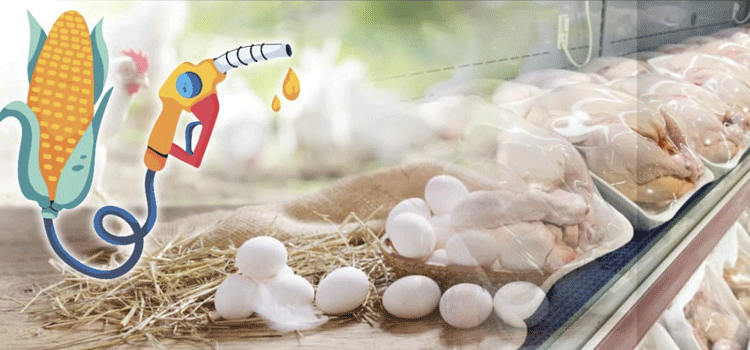
On 16 October 2026, India’s oil marketing companies invited bids for 11 billion litres of ethanol for 2026-27 and, for the first time, set sugar diversion to zero. Every litre must now come from maize, broken rice, surplus FCI rice or C-heavy molasses. For the poultry industry, which buys roughly half to 60% of India’s maize, this is not an energy story. It is a feed-security story.

Serial Entrepreneur, Researcher & Strategic Consultant | LinkedIn| Email
The argument of this article is simple: India cannot run fuel policy, feed policy and food policy in separate silos. Energy security is a legitimate national goal. But if it is pursued without a feed balance sheet, the bill lands on the independent poultry farmer first and eventually on the protein-poor households.
The numbers that frame the debate
In four years maize went from a marginal ethanol feedstock to the backbone of the blending programme, while feed-grade maize roughly doubled in price.
|
Indicator |
Then | Now |
Source |
| Maize share of ethanol blending | 0% (ESY 2021-22) | ~37% (ESY 2025-26) | Lok Sabha via ISignal |
| Maize used for ethanol, 2025-26 | — | ~12.6 MMT (for ~4.8 bn litres) | ISignal |
| Maize-ethanol procurement price | ₹52.92/litre (2021-22) | ₹71.86 (2025-26); ₹68.86 in new tender | ISignal, Channel IAM |
| Maize price to poultry farmers | ₹12–14/kg (2019) | ₹27–28/kg (2026) | ISignal |
| Poultry feed price | ~₹25/kg (Apr 2026) | >₹30/kg (Sep 2026) | Business Today |
| Maize output | 55 MMT record (2025-26) | USDA sees ~10% fall in 2026-27 | ISignal, Business Today |
| Ethanol tender, 2026-27 | Sugar allowed | 11 bn litres, sugar diversion zero | Business Standard / Reuters |
Two cautions apply. Production estimates diverge sharply between sources, and record output did not prevent record prices, which itself signals that demand, not harvest, is the binding constraint.
1. Who competes for maize?
Poultry is the largest buyer of maize, but ethanol is now the buyer with the strongest pricing power, because its offtake price is administered and guaranteed.
Matrix 1: The maize demand contest (author’s assessment)
| Claimant | Approx. share of demand | Price it can pay | Policy backing | Ability to switch feedstock |
| Poultry feed | ~50–60% of maize | Low: tied to volatile egg and broiler prices | Weak: no price support | Limited: maize is ~55% of feed by weight |
| Ethanol distilleries | ~12.6 MMT, roughly a quarter of 2025-26 output | High: OMC price of ₹68.86/litre | Strong: E20 mandate, assured offtake | High: FCI rice, broken rice, damaged grain |
| Starch and food processing | Moderate | Medium–high: branded pass-through | Neutral | Low |
| Dairy, aqua and other livestock | Moderate | Low–medium | Weak | Medium |
The asymmetry is the story. The claimant with the most flexibility and the strongest backing sets the marginal price, and the claimant with the least flexibility pays it. Shares are drawn from Business Today, Poultry India and ISignal.
2. Who absorbs higher costs?
Costs flow to whoever has the least bargaining power, and in Indian poultry that is the independent farmer. With feed making up 65–75% of production cost, a ₹5/kg rise in feed cannot be absorbed by margin. In Tamil Nadu in August 2026, eggs fetched about ₹5.20 at the farm gate against a ₹5.50 cost, and broilers ₹80/kg against ₹110 (Poultry India).
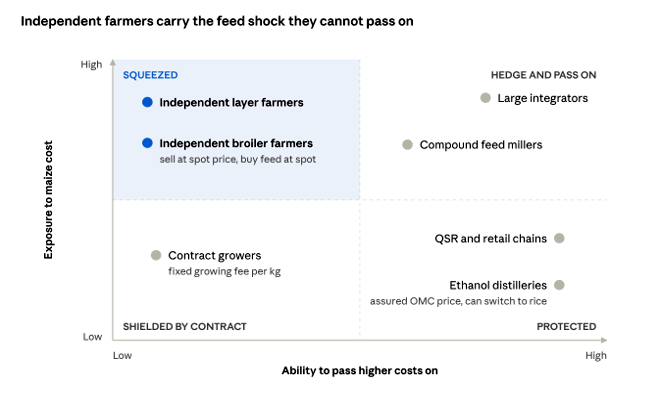
Integrators can hedge, contract-farm and stretch working capital; contract growers are paid a fixed fee. Independent farmers buy feed at spot and sell birds and eggs at spot, so they absorb the gap. The Poultry Federation of India notes that even slight retail increases provoke backlash, so prices lag costs (ISignal). Dun & Bradstreet similarly warns that procurement and inventory costs will stress businesses before shoppers see higher prices (NewsBytes). Consumer price indices therefore understate the stress inside the value chain.
3. Is ethanol the whole story? No.
Ethanol is the most persistent driver of the feed shock, but it is not the largest single driver in 2026. Blaming it for every rupee would weaken the industry’s case.
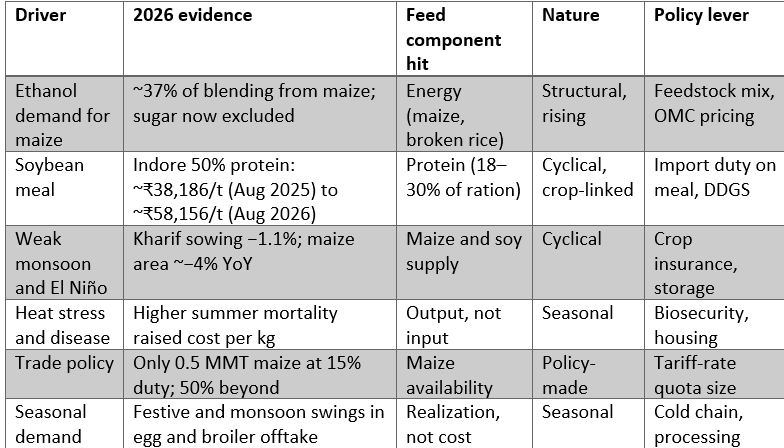
The soybean meal surge of roughly 50% in a year likely added more to the 2026 feed bill than maize did. Ethanol’s distinctive damage is different: it raises the floor under maize prices permanently, so every weather or soy shock now lands on a higher base. Sources: industry feed-cost analysis, Dun & Bradstreet via BW, Brinda Foods, ISignal.
4. What happens to nutrition?
The egg is India’s cheapest complete protein, and the households most dependent on it are the most price-sensitive. Farmer associations report egg production costs up around 40% as maize and soymeal rose (ISignal). Even a partial pass-through matters for mid-day meal budgets fixed in rupees, and for low-income families who trade down to cereals first. This is the question policy has not yet measured: the protein elasticity of the ethanol programme.
5. Can supply keep pace?
Only if productivity, not acreage, does the work. Three facts define the gap:
- Demand growth: poultry grows about 8% a year, needing roughly 1.5 MMT of extra maize annually (Poultry India).
- Yield gap: Indian maize yields 3–4 t/ha against a potential of up to 11 t/ha with better seed, per the Poultry Federation of India (ISignal).
- Land trade-off: maize expansion is displacing soybean and pulses, raising the protein-meal and edible-oil import bill that E20 was meant to cut, as economist R. Ramakumar argues (ISignal).
One underused offset sits inside the ethanol chain itself: DDGS, the protein-rich by-product of grain distilleries. Standardized quality grading would let feed millers replace part of their soymeal with it, turning a competitor into a partial supplier.
6. What should change?
India needs a single fuel-feed-food balance sheet, with triggers that act before prices spike rather than after.
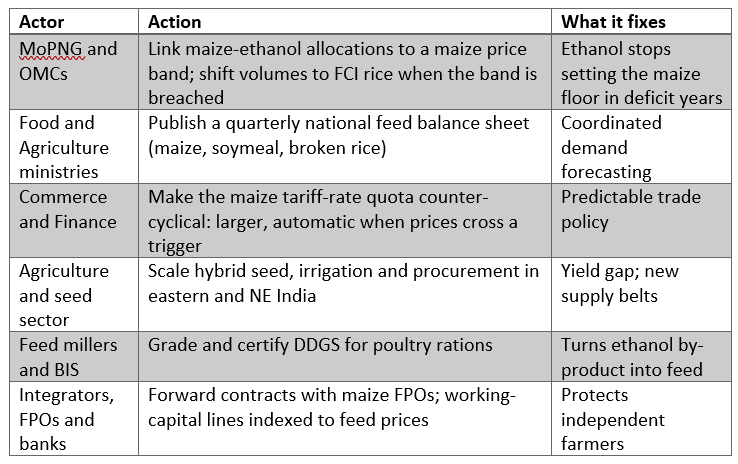
For the industry, the near-term priority is clear: build procurement buffers before the rabi crop, and lobby for rules-based triggers rather than one-off duty waivers.
Conclusion: fuel and feed must share one ledger
India’s ethanol programme has delivered E20 and real foreign-exchange savings. But with sugar now out of the 2026-27 tender and maize output expected to fall, the grain burden on poultry will rise, not ease. The choice is not fuel or feed. It is whether India plans for both, or lets the independent poultry farmer and the protein-poor household quietly pay the difference.
Sources
- Centre sets sugar diversion for ethanol at zero in 2026-27 tender, Business Standard / Reuters, 16 Oct 2026
- Centre stops sugar diversion for ethanol, Channel IAM, 17 Oct 2026
- Why diverting maize for ethanol is affecting poultry farmers, ISignal / Newslaundry, 28 Sep 2026
- Sugar to maize: why ethanol demand could make eggs and chicken costlier, Business Today, 16 Sep 2026
- Egg prices jump 40% as ethanol pushes maize up, Business Today, 26 Aug 2026
- Monsoon deficit puts rice, maize production at risk, Dun & Bradstreet via BW Businessworld, Oct 2026
- Dun & Bradstreet India warns monsoon could raise food costs, NewsBytes, 12 Oct 2026
- Tamil Nadu poultry farmers concerned over maize diversion, Poultry India, Aug 2026
- Maize availability, poultry growth and policy reforms, Poultry India, 2026
- Maize kharif 2026 sowing update, Brinda Foods, Aug 2026
- Feed-cost analysis (soybean meal and maize quotes), LinkedIn industry post, 2026 — verify before publication