


Professor & Mentor, Centre for Entrepreneurship & Innovation, Mahindra University · Founder, Utpan- An Agri Fintech Platform
dranjangoswami@gmail.com
Mobile No: +919449871819
India’s poultry sector stands at a defining inflexion point. Powered by robust macroeconomic tailwinds, a young and aspirational population, and rapidly evolving consumer preferences, the industry is poised to double its scale within a decade. Yet, capturing this opportunity demands a fundamental reimagining, away from commodity-driven, price-competitive models toward technology-enabled, brand-differentiated, and sustainability-compliant enterprises.
This article synthesises the key themes presented by the author at the VIV Workshop (April 2026): India’s growth trajectory, global market dynamics, shifting consumer behaviours, digital and sustainable innovations, decommodification strategies, the 5C framework for global competitiveness, and the imperative of collaborative ecosystem building.
SECTION 1 | INDIA’S ECONOMIC GROWTH STORY
India has emerged as one of the most dynamic economies of the 21st century. Between 2014 and 2024, the country sustained an average GDP growth rate of 7.6% (excluding the COVID-19 contraction of −6.6% in FY21), firmly establishing itself as the world’s fastest-growing major economy. The V-shaped recovery — with 8.7% growth in FY22 — underscored the structural resilience of the Indian economy. By 2025, India’s GDP crossed USD 4.15 trillion, making it the fourth-largest economy globally, with a stated national target of USD 5 trillion by 2027–28.
For agribusiness and the poultry sector in particular, these macroeconomic fundamentals are not merely statistical headlines; they are the bedrock of a multi-decade demand expansion story. Six drivers converge to make India poultry’s single largest opportunity:
- A population of 1.45 billion — the world’s second-largest consumer market
- Rising disposable incomes, with per capita income at ₹1.97 lakh (FY24, nominal)
- Urbanisation at 36% and climbing at over 1% per annum
- A dietary shift toward protein-rich foods across all age groups
- A young demographic profile, with 65% of the population under 35 years of age
- Projected agri-food sector CAGR of 8–9% through 2025–30
“The question is no longer whether Indian poultry will grow — it is whether India’s poultry businesses are prepared to capture that growth.”
SECTION 2 | GLOBAL & INDIAN POULTRY MARKET
The global poultry market, valued at approximately USD 490 billion in 2024, is projected to grow at a CAGR of 8.2% through 2030. Global broiler meat production stands at 130 million metric tonnes (MMT), while global egg production reaches 83 MMT annually.
India’s Market Position
India occupies a position of growing strategic significance in global poultry:
- Ranked 4th globally in broiler meat production
- Ranked 3rd globally in egg production
- The domestic poultry industry is valued at over USD 27 billion, projected to reach USD 34 billion by 2030
- Annual capacity: over 6,500 million birds slaughtered, 42,000+ registered hatcheries, and 50 million+ livelihoods supported
- 10-year egg export CAGR: from 210,000 MT (2015–16) to 452,000 MT (2024–25), with export value growing from USD 62M to USD 168M
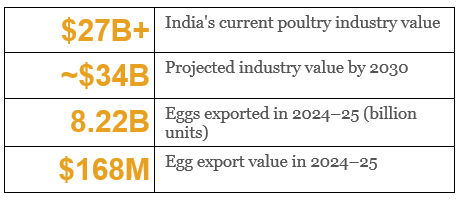 India currently ranks fifth globally in egg exports, with key markets in the Gulf and Southeast Asia. The Netherlands, Turkey, and Poland lead the global export rankings, but India’s cost competitiveness and scale position it for a rapid ascent — particularly as geopolitical shifts redirect trade flows across the Middle East.
Section 3 | CONSUMPTION PATTERNS & THE NEW INDIAN CONSUMER
India’s per capita poultry consumption tells a story of significant opportunity. At 6.2 kg per person per year, India remains approximately 2.5 times below the world average of 15 kg. This is not a sign of market saturation — it is a measure of addressable headroom. China bridged a comparable gap within 15 years; India is narrowing the gap at approximately 0.4 kg per year, and on its current trajectory, could reach 10 kg per capita by 2035, effectively doubling the market.
Similarly, per capita egg consumption grew at approximately 5% CAGR over 14 years. India’s national target of 180 eggs per capita by 2030 (DAHD) would require annual production of 260 billion eggs — necessitating a 30%+ capacity addition across the value chain.
The Six Drivers of Consumer Behaviour Shift
Six structural forces are reshaping the demand landscape for poultry products in India:
- Urbanisation: Urban consumers spend 3x more on poultry than rural counterparts. Nuclear families prefer convenience formats, and quick commerce platforms (Blinkit, Swiggy Instamart) are driving impulse purchase behaviour.
- Health Consciousness: Protein awareness surged 40% post-COVID. Poultry, perceived as lean protein, is benefiting from a decisive shift away from red meat. Demand for antibiotic-free (ABF) and cage-free products is growing rapidly.
- Rising Incomes: India’s middle class is expected to double by 2030. Willingness to pay premium for safe, branded poultry is increasing, with per capita food spend rising 8–10% annually.
- Digital Commerce: The online meat category grew 4x post-2020. D2C brands such as Licious and FreshToHome are scaling, with social media actively influencing protein diet choices.
- Ready-to-Cook / Ready-to-Eat: Marinated and value-added formats are growing at 20%+ CAGR, driven by busy urban households and the QSR boom (McDonald’s, KFC, Popeyes).
- Sustainability Concern: Gen Z consumers demand ethical sourcing and transparent supply chains. Organic and free-range products command a 40–60% price premium, with packaging and traceability becoming active purchase criteria.
The India 1 / 2 / 3 Consumer Segmentation Framework
A structured approach to consumer segmentation is essential for any serious market participant. The three-tier India 1/2/3 framework maps poultry demand across distinct consumer strata:
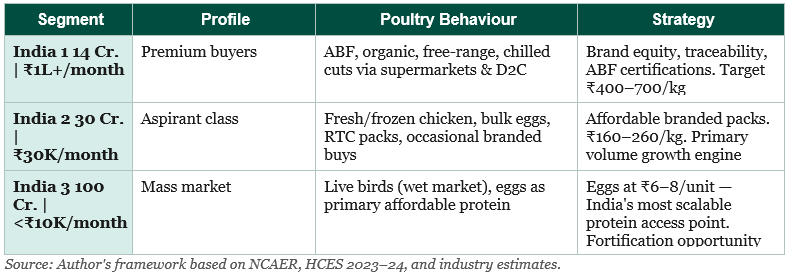 The strategic implication is clear: India 1 drives margin through premiumisation; India 2 drives volume through branded affordability; India 3 represents the opportunity for low-cost nutritional access at scale. A winning poultry enterprise must design differentiated product lines for all three strata — simultaneously.
SECTION 4 | DIGITAL TECHNOLOGY, SUSTAINABILITY & ESG
Digital Technology & Automation
The convergence of IoT, artificial intelligence, and automation is fundamentally restructuring the economics of poultry farming. Smart shed management systems — combining environmental sensors, automated feeding and drinking lines, and real-time health monitoring — are delivering measurable performance improvements:
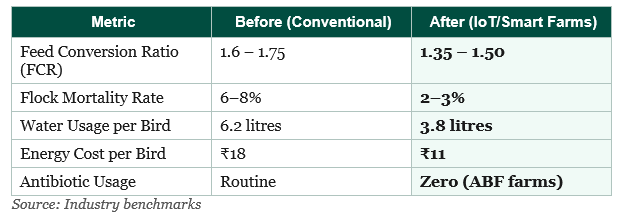 Blockchain-based farm-to-fork traceability is transitioning from a differentiator to a prerequisite for institutional buyers and export markets. AI-driven disease prediction models are enabling early intervention, dramatically reducing flock losses. Robotics in processing is improving throughput consistency and food safety compliance.
Sustainability & ESG Imperatives
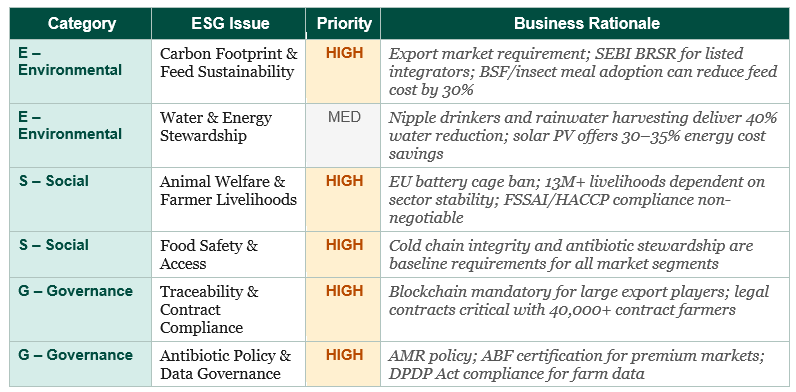
Sustainability in poultry operations is no longer a corporate social responsibility (CSR) exercise — it is a market access and cost management imperative. The following table maps key ESG issues, their priority levels, and their business rationale for Indian poultry operators:
SECTION 5 | DECOMMODIFICATION & GLOBAL COMPETITIVENESS
The Value Ladder: From Commodity to Experience
The single most important strategic transition for Indian poultry businesses is decommodification. Commodity pricing — driven by live bird transactions, unnamed farm output, and wet market sales — destroys value and compresses margins to the bone. The escape route is a deliberate, upward migration along the value ladder:
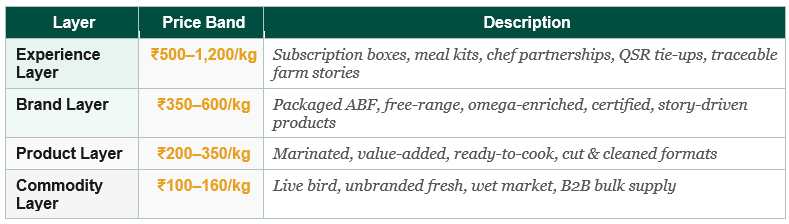 The shift from commodity to experience is not merely cosmetic — it involves rethinking the entire business model: from price-per-kg to value-per-meal, from nameless farm output to QR-traceable farm-to-fork stories, from wet market transactions to subscription-based D2C relationships.
The 5C Framework for Global Competitiveness
For businesses aspiring to compete in global markets, the 5C Framework provides a strategic roadmap. Winning on all five dimensions is not a choice — it is the minimum requirement for enduring global market presence:
“Mastering the 5Cs is not a choice — it is the minimum requirement for enduring global market presence.”
SECTION 6 | COLLABORATION OVER COMPETITION
One of the most counterintuitive — yet empirically well-supported — insights for the Indian poultry sector concerns the limits of competitive rivalry. Pure competition, characterised by price wars and fragmented ecosystems, systematically weakens the industry’s collective capacity to grow, innovate, and withstand systemic shocks.
The costs of unchecked competition are measurable and severe: price-driven rivalry erodes reinvestment capacity; parallel infrastructure inflates operational costs through resource duplication; fragmented R&D prevents any single player from absorbing the full cost of technology adoption; incompatible cold chains block traceability at scale; and when disease outbreaks (such as Avian Influenza) demand coordinated industry responses, siloed players cannot mount effective collective action.
The Strategic Balance Imperative
The answer is not the absence of competition — it is strategic balance. The principle is straightforward:
- Compete where differentiation matters: quality, innovation, brand, and consumer experience.
- Collaborate where collective progress creates value: biosecurity protocols, cold chain infrastructure, industry standards, and policy advocacy.
- Share infrastructure where it makes strategic sense: cluster-based development, shared logistics hubs, joint cold storage facilities.
- Co-invest in public goods: R&D, veterinary and technical training, industry-wide data platforms.
- Advocate collectively: for export policy, farmer welfare schemes, and regulatory harmonisation with global standards.
“Compete where differentiation matters; collaborate where collective progress creates value.”
India’s aspiration to become a global poultry export powerhouse will not be realised by individual enterprise heroics. It will be built through ecosystem leadership — the ability of diverse sector participants to create shared infrastructure, shared standards, and shared ambition.
CONCLUSION | KEY TAKEAWAYS
The reimagining of Indian poultry is not a singular event — it is an ongoing strategic transformation. Six themes crystallise the imperative for the next generation of poultry leaders:
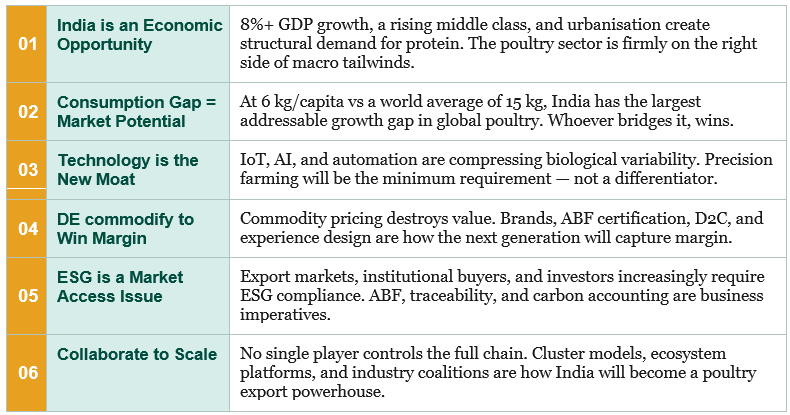
“The future of Indian poultry belongs to those who think like technologists, act like entrepreneurs, and build like ecosystem leaders.”
More about the Author: Click here