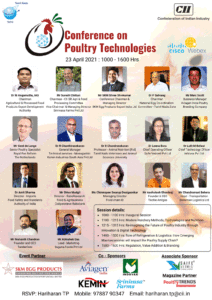

CII TNTDPC is organizing a “Conference on Poultry Technologies” with the focus on poultry industry, poultry technologies and business.

The conference attempts to bring an in-depth knowledge of the existing scenario in the poultry processing industry and the emerging trends and technologies for the Indian poultry sector. This forum would pave a way for Industry collaboration by means of technology transfer, adoption of automation and innovative & new product development which will shape the future of the poultry and chicken processing sector both domestically and internationally.

Conference Objectives:

  • To disseminate an awareness on poultry processing and technologies.
  • To facilitate knowledge flow by working with organizations through bi-lateral/multi-lateral cooperation mechanism to know the effects of high technology on meat and poultry processing industry.
  • Platform to know about emerging Trends in Retailing & Branding of Poultry Products and poultry feed industries.
  • To establish linkages and partnerships with potential stakeholders to exchange and share their experiences in poultry industry business.
  • Platform for Industry and Institutes to collaborate and commercialize.

Sessions

  • Modern Hatchery methods, Technologies and Nutrition
    Incubation and hatching / Brooding management / Performance and vitality / Commercial selection / Genetic diversity and approaches / Health and disease management
  • Re-imagining the future of Poultry Industry through Digital innovation
    Blockchain role in traceability / AI in processing / Feed cost management / Feed conversion ratio / Feed consumption monitoring / Digital recording / Health analysis and monitoring
  • Role of Refrigeration & Logistics: How emerging macroeconomic will impact the poultry supply chain?
    Refrigeration / Retail industry / Automation / Transport / IOT in value chain
  • Regulation, Value Addition and Branding
    FSSAI regulation / Quality management / Brand Marketing / Value added products / Ready to Eat chicken products.

Speakers:

  • Dr M Angamuthu, IAS, Chairman, APEDA
  • Mr Suresh Chitturi, Chairman – CII SR Agri & Food Processing Committee, Vice Chairman & MD, Srinivasa Hatcheries Pvt Ltd
  • Mr SKM Shree Shivkumar, Conference Chairman & MD, SKM Egg Products Export India Ltd
  • Mr G B Sundararajan, MD, Suguna Foods Private Ltd
  • Dr P Selvaraj, Chairman, NECC, Tamil Nadu Zone
  • Mr Gerd de Lange, Senior Poultry Specialist, Royal Pas Reform, The Netherlands
  • Mr Marc Scott, Business Manager, Aviagen India Poultry Breeding Company
  • Dr D Chandrasekaran, Professor – Animal Nutrition [Rtd], TNVASU
  • Dr R Chanthirasekaran, GM,Technical Services-Monogastric , Kemin Industries South Asia Pvt Ltd
  • Dr Leena Bora, COO, Saife Vetmed Pvt Ltd
  • Dr Lalit M Belwal, Chief Technology Officer, Indovax Pvt Ltd
  • Mr Anil Dhumal, Managing Director, Dhumal Industries India Pvt Ltd
  • Ms Chinmayee Swarup Deulgaonkar, Managing Director, Food chain ID
  • Dr Amit Sharma, Director – Imports, Food Safety and Standards Authority of India
  • Mr Shiva Mudgil, Director – RaboResearch Food & Agribusiness, Coöperatieve Rabobank U.A
  • Mr Chandramani Behera, Head – Transportation, Snowman Logistics Ltd
  • Mr Ash Bharadwaj, Founder & CEO, Techie Amigos
  • Mr Nishanth Chandran, Founder and CEO, TenderCuts
  • Mr Abhishek Das, Lead – Marketing, Suguna Foods Pvt Ltd

Note: The Conference will on organised on Webex Platforms. 

To register for the conference, click: https://forms.gle/BurA1p1zouHaFpU18

Instructions:

1. Webex from Desktop/Laptop – Please use the given link for instructions (https://help.webex.com/en-us/nrbgeodb/Join-a-Webex-Meeting)
2. Webex Mobile application – Please use the given link for instructions ( https://help.webex.com/en-us/njd6v2l/Install-the-Cisco-Webex-Meetings-Mobile-App )


Conference on Poultry Technologies

Synopsis: This article intends to look at the entrepreneurial dynamics of the family-owned businesses especially in relation to the small and medium enterprises in India. It takes an attempt to understand about business dynamics of family own businesses (FBs), the crucial facts about FBs , advantages, challenges and bitter truth about FBs. It also looks at the possibilities of needful steps towards balancing between business entity and family.

The Background: Indian economy comprises of 1000s of small and medium sized enterprises and more than 80% of these enterprises are of family own businesses. Many of those enterprises are managed by the first generation, some of them are by second generations and a few of them are being run by the third generation. Around 90% of all businesses around the world. 70%-90% of global GDP is contributed by the family-owned businesses. Between 50%-80% of jobs in the majority of countries are generated by family-owned businesses and ~ 85% of start-up companies around the world are family-owned businesses.

The global data suggests that there are about ~30% of companies in developed economy & ~ 80% in the growing economy is governed by families respectively.

Indian Poultry Sector: An Overview
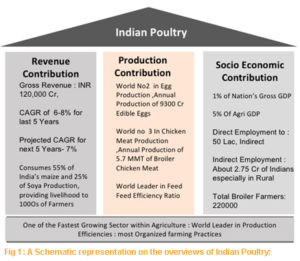
Indian Poultry sector has witnessed a paradigm shift in last few decades and has metamorphosized as one of the most promising industry from a mere backyard farming activity over the years. The Indian Poultry sector is today is ~ INR 120,000 Cr Industry, one of the largest sector within the Agribusiness sector in India. The Industry has grown at a CAGR of 7 % in last 10 years providing direct and indirect employment to more than 5 million Indians producing 5.7 Million of MT of Chicken meat and ~94 Billon of edibles Eggs.

Fig 1

The poultry sector is contributing to 5% of the India’s Agricultural GDP and considered to be having one of the most organised farming practices among all the agriculture produced. The Sector is a star performer and global leader next to brazil in terms of conversion of feed resources to bio-available protein with effectiveness. Indian poultry sector is one of the early adaptor of western concept of contract farming model by sharing resources with farmers. Today 80% of the active farmers Out of total of 220,000 poultry farmers Indian are the under the umbrella of contract farming. The Sector is likely to grow further at an CAGR of 7.5% for next 5 years as per the industry estimation with the ongoing shift in consumer behaviour in term of converting from carb based food to protein reach diet.

The future trend in India Poultry in relation to enterprise management
The perspective of business dynamics of Family-owned businesses is highly relevant to Indian Poultry Sector. ~95% of the poultry sector enterprises in India are driven by the family members. Although there are a few examples of appointing professionals and designing board structure but apparently the control of the businesses and related decisions has always been with the family members.

Family Own Businesses (FBs)- Definition: Broadly the family-owned businesses can be defined as follows:

  • A business where multiple members of the same family are involved or control the business as major owners or managers. A business governed and/or managed with the intention to shape and/or pursue the vision of the business held by a dominant coalition controlled by members of the same family or a small number of families.
  • A business where the decision-making rights are in the possession of the person(s) or family who established the firm, or the person(s) or family who has/have acquired the share capital of the firm. A business where the person who established or acquired the firm or their families possess 25% of the decision-making rights mandated by their share of capital (European Union definition 2009).

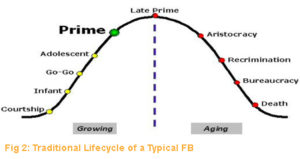
Fig 2

Growth phases of the Family own Businesses:

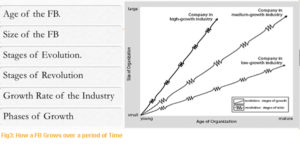
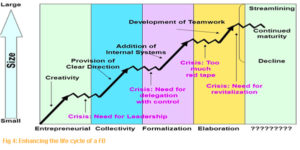
A family-owned business grows over the years in different dimensions. A FB grows as its age and size of the business increases. The growth in the FB are also determined by its stages of evolution and revolutions. The industry growth rate and market forces also determine the phases of the growth of a FB.

Fig 3

Fig 4

Salient Features of the Family own Businesses:

  • FBs have higher profitability in the long run
  • FBs are Resilient and more focused
  • FBs are financially more prudent
  • FBs have a more long-term outlook than Short term growth
  • FBs are more likely to look after the community

Positive aspects of FBs:

  • Well known family name, building credibility and trust helping the businesses to grow
  • Strong shared values
  • Long-term perspective not solely aiming to please the shareholders
  • Informal structure facilitating agility in decision making
  • Deep understanding of the business and the market
  • Close ties with government (especially in emerging markets)
  • Easier access to local resources (especially in emerging markets)

Hard facts about FBs:

  • Research has shown that globally less than 30% of family businesses are successfully passed to the second generation, and less than 10% are successfully transferred to the third. The first generation builds the company, the second preserves it and the third squanders it” “It is only but three generations from shirtsleeves to shirtsleeves.”

Balancing the wagon wheel: Balance between families and businesses

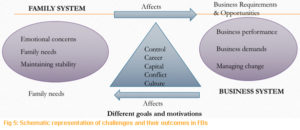
The family-owned businesses often find it difficult to balance between the family system and business requirements & opportunities. The emotional concerns and family needs adversely affect the business performances and business demands. The outcome of the difference between the family and the business witnesses a diversion from the core competencies, goals and motivation.

Fig 5

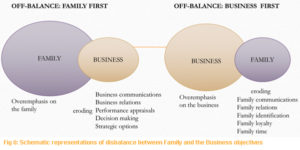
The disbalance between the core value of the family and the businesses in the family-owned businesses impact both the family and he businesses adversely. There have been incidences of over emphasis on family concerns over the business objectives eroding the business communication and relations impacting the decision marking and strategic options of the company. On the other hand, in some of the family own businesses, there is overemphasis on the business’s objectives affecting the family communication, relations, family identifications and loyalty.

Fig 6

Challenges in FBs:

The issues in the family-owned businesses can broadly be categorized in relation to:

A. Issues related to the management of the business

B. Issues related to the management of family relations: The founder and the family dynamics

A. Issues related to the management of the business

  • Lack of common vision and shared values
  • Lack of Clears Roles with accountability
  • Lack of planning for growth- Poor Self and Time management
  • Lack of necessary financial resources
  • Misalignment of strategies
  • Misfit in organizational structures
  • Un scalability
  • Problems in decision making
  • Lack of proper governance systems
  • Fear of Conflict
  • Poor next generation leadership skill development
  • Issues in attracting and retaining talent
  • Weak HR systems

B. Issues related to the founder:

  • Reason for building this business
  • The relationship with the business
  • Rivalry with outsiders and other family members

Issues related to the family dynamics:

  • Inadequate experience of family members
  • High risk aversion
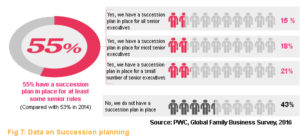
  • Succession planning
  • Family conflicts
  • Problems in decision making
  • Governance

Fig 7

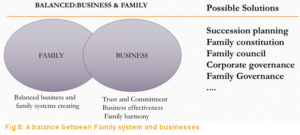
A balanced business and family systems with a methodical succession planning, formulation of a family constitution, family council and a fair family governance is key to the successful transition of a family-owned business.

Fig 8

Do's & Dont's

About the author:

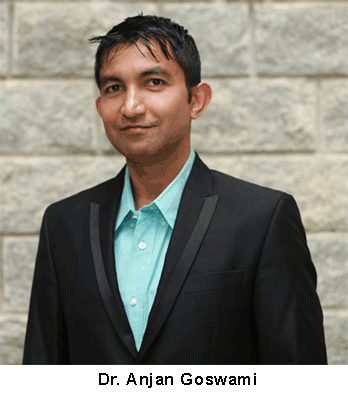
Dr. Anjan Goswami, Director in R J Feeds Pvt Ltd, and Navjeevan Hatcheries Pvt Ltd. have got over thirteen years of Enterprise management experience in the Poultry and Food Sector across all the verticals. He has been instrumental in innovating and implementing different types of revenue and investment sharing models which are being adopted by different companies in the sector.
Dr. Anjan has mentored and co-founded enterprises in the Health and Service sector. He is the present General Secretary of Karnataka Poultry Farmers’ and Breeders’ Association (KPFBA). Dr. Anjan brings exposure in the areas of Business Management strategy, financial analysis, investment advisory, due diligence, and corporate restructuring of businesses and has experience of successfully closing overseas M&A deals. The Equity, Debt investments, Joint Ventures, and M&A Agreements have been his area of expertise as well.
Dr. Anjan is a Doctoral Research Fellow at ISB Hyderabad, holds an MBA from the Indian Institute of Management, Bangalore. Apart from being a M.V.Sc, his academic exposure also includes advanced business management training from “Capsim Management Simulation Inc” USA and studies on rural sociology under the program “understanding rural India” from Azim Premji University, Bangalore.

Vacancy for the Position: Assistant Sales Manager – Techno commercial (BVSc. or MVSc.) – Layer Feed Sales
Job Locations: 1. Uttar Pradesh 2. West Bengal

Job Description: •Sales & Marketing of Layer Feed Sales in assigned area by management. •Achieve Sales targets as desired by organization. •Arrange technical seminars, farmer meetings in assigned areas. •Develop new layer feed dealers/sub dealers /big layer birds farmers for increasing sales volume. •Responsible for layer feed sales growth. •Day to day sales & technical reports to management. •Provide technical services, disease diagnose and treatment to layer birds. •Arrange dealers and farmers meetings related to product promotion, chicks & birds health, bio-security and farm management issues etc.

Candidate Profile: Qualification: BVSc. or MVSc., 2-5 yrs. in layer feed sales or willing to do layer feed sales. For IPMT Candidates, 7-10 yrs. of experience into layer feed sales. Male Candidate.
Maximum Age: Up to 45 years.
Salary is no bar for deserving candidates Good Selling, Technical & Convincing Skills.

For more information contact Solutions at Email – Info@infinitohr.com WhatsApp – 9711113348

KPFBA Logo

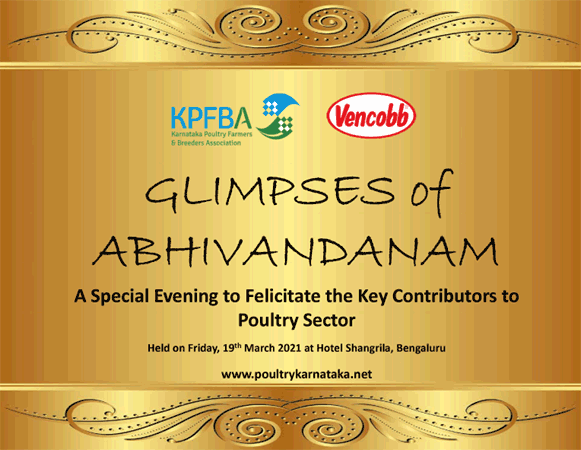
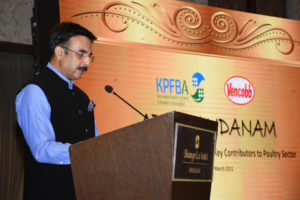
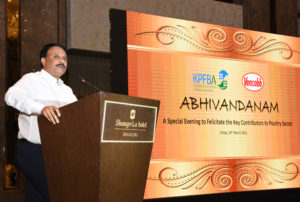
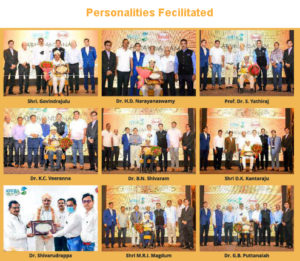
Karnataka Poultry Farmers & Breeders Association (KPFBA) felicitated nine distinguished personalities of the poultry sector in a programme called ‘Abhivandanam’, organised at Hotel Shangri-La, Bengaluru on March 19, 2021.

Announcing at the felicitation programme, Dr. Sushanth Rai said that a State-of-the-art poultry disease diagnostic lab soon in Bengaluru.

Dr. RaiThe state-of-the-art Poultry Disease Diagnostic Laboratory and R&D Centre is coming up on the campus of the Karnataka Veterinary, Animal and Fisheries Sciences University (KVAFSU) here in Bengaluru. The Centre will be a boon to Karnataka and also the country as it will be involved in pioneering research in the field of poultry sciences, according to Dr. B.Sushanth Rai, President, KPFBA.
KVAFSU had allotted a building on the campus and extended all support to set up the Centre which is going to be a historic milestone in the journey of KPFBA. The Vice Chancellor of KVAFSU, Dr. H.D.Narayanaswamy said that the R&D Centre will enormously help the poultry sector in understanding and dealing with various disease outbreaks.

The President acknowledged the efforts of Dr. G.B.Puttanaiah; Dr. Narayanswamy,Vice Chancellor, KVAFSU; Dr.Yathiraj, Member of Board, KVAFSU and Dr. K.C Veeranna, Registrar, KVAFSU in getting the Centre.

‘Unfounded rumours’

Dr. Sushanth Rai recalled how rumours regarding chicken being disease carriers spread faster than the Corona virus, resulting in the collapse of the broiler market like never before. The KPFBA and other associations in the country had to run from pillar to post not only to quell the ‘unfounded rumours’ but also restore confidence in the market and this was possible in Karnataka as several government officials supported the sector.

Dr.Sushanth Rai thanked the timely cooperation and coordination of many officials such as, Dr.Shivarudrappa; Dr. M.T Manjunath, the then Director, Dept of Animal Husbandry & Veterinary Services; Mr. Ibrahim, IAS, Principal Secretary; Dr. O.P Chowdry, IAS, Joint Secretary, Govt of India; Pawan Kumar Agarwal, IAS, Secretary, Govt of India; and Smt. Vandita Sharma IAS – Development Commissioner. He also acknowledged the Government of Karnataka’s initiative for releasing a pro-poultry advertisement in all the major dailies to remove misconceptions about chicken. He also appreciated Mr. Inayath Ulla Khan, Executive Secretary for playing active rule in delivering his duties specially during and post lockdown.

The poultry sector, he said, was fortunate to have representation in the Karnataka Legislature as well as in the Parliament. The KPFBA congratulated Mr. Ranjit Reddy and Mr. Chinnaraju, both MPs and Mr. Govindaraju, MLC.

Poultry is farming activity

Mr. Govindaraju said poultry should be treated as a farming activity and not industry. He said in Karnataka there may be nearly 30,000 poultry farmers and a couple could raise 10,000 birds earning Rs. 60,000 per month.

India has 25 veterinary colleges, but lags behind

Prof.Dr. S. Yathiraj, Member of Board, KVAFSU, and former dean of KVAFSU said there was need for introspection within the sector as India is far behind many countries in the world in terms of poultry growth. The US has about 25,000 poultry farmers and only 25 veterinary colleges but was in the second position, while India with 55 veterinary colleges and 12 veterinary universities and about 30,000 farmers in Karnataka alone was ranked way behind countries such as Argentina, Thailand etc. Poultry is the best source of protein and there is need to popularise it more and more.

Shortage of trained manpower

Dr.K.C Veerannaa, Registrar, KVAFSU said as there was shortage of trained manpower in the poultry sector there was need to expand diploma and certificate courses. Congratulating the KPFBA for mooting the lab, he hoped that it would help the small farmers.

Need to focus on marketing

Mr. M.R.I Magdum, General Manager, VHPL, who is known as ‘management guru’ in the poultry sector recalled how the late B.V.Rao took risks and introduced many new methods of poultry management. He remembered ‘how Rao sahib asked the VHPL team to experiment, innovate. Till 1982, there were no poultry birds in the cages. We introduced it and there were positive results as the quality of chicks was good. In 1986 for the first time we introduced broiler parents in to the cages. The production reached a phenomenal 87 % and in the slats system it was around 78 per cent. The credit goes to Rao sahib who said unless we take risks, there is no growth. If we have to grow, we have to focus on marketing.”

Dr. G.B Puttannaiah, Chairman of the Technical Committee of KPFBA for many years gave the background to how a decision was taken in just four meetings to set up a state-of-the-art poultry diagnostics laboratory in KVAFSU. He acknowledged the efforts of the Vice Chancellor, Dr. Narayanaswamy and Dr. Yathiraj and other other KVAFSU officials for understanding the needs of the sector and acting quickly upon it.

National Poultry Register soon

The Government of India is soon coming out with a National Poultry Register which will ensure authentic national Dr. Mahesh Picdocumentation of valuable sovereign genetic resources. Documentation of indigenous breeds is expected to help in their sustainable use, improvement and preservation, according to Dr. P.S.Mahesh, Joint Commissioner, Government of India and Director of Central Poultry Development Organization and Training Institute.

He was addressing the members of KPFBA as part of the ‘Abhivandanam’ (felicitation) programme for key contributors to the poultry sector, here recently. Dr. Mahesh exhorted the members to help in the enumeration of the poultry which would commence soon. It will be designed similar to Arogya Setu app as to help in easy digital registration of poultry resources. The NPR is essential to have proper records of farmers and other players and poultry and provide necessary inputs for the organized growth of the sector, he said.

National Poultry Board on the anvil

Dr. Mahesh also mentioned that also on the anvil is setting up a National Board for Poultry similar to the Coffee Board or Tobacco Board to come up with strategies for the growth of the poultry sector. Presently, the focus is on supply management than on ‘demand development’ and cited the example of a poultry company which had used celebrity endorsements and it was making huge business post that. Poultry has the best nutrition and it was imperative to run campaigns such as ‘Dawa math khao, anda khao’ (don’t eat medicine, eat eggs).

Many eminent poultry personalities, business leaders, scientific communities, government officials, academicians and other stake holders such as Dr. Devegowda, President, IVPI; Dr.Muniyellappa, Scientist, IAH &VB , Dr. Byre Gowda, Director, IAH &VBl Dr.Raghavendra Bhat, Director, NIANP and many others graced the occasion.

Pic

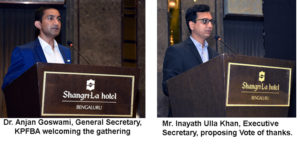
Dr. Anjan Goswami, General Secretary, KPFBA welcomed the gathering while Mr. Inayath Ulla Khan, Executive Secretary, proposed a vote of thanks.

The dignitaries honoured included: Sri. Govindaraju, MLC, Karnataka Legislative Council; Dr.Narayanaswamy, Vice Chancellor, KVAFSU; Prof.Dr. Yathiraj, Member of Board, KVAFSU; Dr.Veerannaa, Registrar, KVAFSU; Dr. B.N Shivaram, Director, Dept. of AH & VS; Sri. D.K Kantaraju, Chairman, Karnataka Cooperative Poultry Federation (KCPF); Dr.Shivarudhrappa, K.H. Managing Director, KCPF; Mr. M.R.I Magdum, General Manager, Venkateswara Hatcheries Pvt Ltd. and Dr. G.B Puttannaiah, Chairman, Tech Committee, KPFBA.

Fecilitation

Source: KPFBA

The Fishmeal supply-demand situation between China and Peru decides the global outlook. Peru supply situation is strong and China is not showing any major signs of slowing down.

The Fishmeal demand is likely to increase in China in coming days as Aquafeed production season begins.

Ashish Kulshrestha

Regarding the supply side, Peru, Chile, the Northern European region and the African countries have reported an improvement in terms of available raw material in January 2021 with respect to January 2020 (Source).

With both supply and demand sides showing strength, its not easy to predict what will exactly happen but if the pig sector in China continues to increase the utilization of Fishmeal, we would likely see the price increase.

It is not difficult to understand the Global Fishmeal dynamics. The major exporters of Fishmeal in the world is Peru. China is the largest importer, of course.

China imports approx. 1.5 MMT of Fish Meal per annum. It imports nearly 50% of its requirement from Peru and Chile put together. Another nearly 25% is imported from countries like Vietnam, Thailand, Russia, Mauritania, USA etc. Clearly, it is the supply-demand situation between China and Peru which decides the global outlook.

In January, it was reported that Peru has closed second anchovy season at 88 percent of quota or a total of 2.44 million MT. The quota for next anchovy season starting in April is also expected to be good.

China also seems to be following the policy of importing from different countries apart from Peru in order to reduce its dependence on Peru. So, all other countries, where the plants have been approved for selling in China, will keep selling to China and will be the beneficiary of increased prices.

On a different note, there are environmental concerns about how China is using west African countries water resources to get Fishmeal in a non-sustainable way.

About the author:
Ashish Kulshrestha is Managing Director (Asia-Pacific) at GePro Geflügel-Protein Vertriebsgesellschaft mbH & Co. KG and is based out of Bangkok, Thailand. GePro is one of the leading protein suppliers for the Feed Industry.

Ashish_Kulshrestha

Prices of Soybean, Soybean Meal and Corn have slightly increased in the month of March due to smaller-than-expected U.S. planting intentions. Marine and Animal Protein prices also did not change significantly during the month.

The month end saw an increase of 3.3% in the prices of US Soybean, an increase of 0.6% in the prices of US Soybean Meal and an increase of 6.06% in the prices of US Corn.

US Soybean

US Soybean Meal

US Corn

Clearly, the charts show that there was a kind of slowdown in the prices but they increased on the last day of the month after the U.S. Agriculture Department released smaller-than-expected U.S. planting intentions. So, this was a supply side phenomenon.

The demand side phenomenon is the increasing incidences of ASF in China, due to which there is caution in the air. This is the caution which we are witnessing in the prices since the beginning of the quarter.

The Fish Meal prices have remained flat or softened in some cases as per the reports. The probability of the price increase is high in coming weeks as Aquafeed production speeds up.
The prices of animal proteins from Australia, USA and Europe increased to an extent of 3-4% effectively. The MBMs slid down a little (effect of SBM coming down a bit) but there was no change in the end user price because of volatile freight situation.

New quarter begins and clearly there is a lot of steam left in China’s procurement engine provided ASF incidences don’t increase drastically. Expect the prices to go up otherwise and keep an eye on covid-19 situation.

About the Author: 

Ashish Kulshrestha is Managing Director (Asia-Pacific) at GePro Geflügel-Protein Vertriebsgesellschaft mbH & Co. KG and is based out of Bangkok, Thailand. GePro is one of the leading protein suppliers for the Feed Industry.

Title Photo by eskay lim on Unsplash


Nagpur Veterinary College, Nagpur is organising a National Online Training Programme on “Nutritional Interventions for Livestock and Poultry” from 6 to 8 April 2021 from 1700-1900 hrs IST.

Speakers:
Speakers

Topics of Training
1. Clinical nutritional approaches for augmenting health and production of Dairy Animals.
2. Nutritional considerations for high yielding Dairy Animals.
3. Innovative Research Applications in Poultry Nutrition.
4. Silage preparation: Constraints and perspectives.
5. Nutritional strategies for other Avian species.
6. Nutritional Advancement for Commercial Layers.
7. Nutritional interventions for rearing commercial broilers for chicken processing plant.

Who can participate ?
Academicians, Field Veterinarians, PG and PhD Students, Research Scholars, Industry personnel

Important Note: E Certificate will be provided to registered participants by email.

Last date of Registration: 6th April, 2021

For registration, visit the link https://forms.gle/15Zwk2Ru2GzBoeEe6

AB Vista launches online dietary fibre calculator to help nutritionists optimise animal diets.

AB Vista Logo

AB Vista has launched a free tool to assist nutritionists as they formulate animal diets. The dietary fibre calculator uses average values of global raw materials to calculate the dietary fibre content (plus other more in-depth fibre parameters) of finished animal feed.

The calculator offers the option of entering up to 28 different raw materials, along with the daily total intake in kg, to show the fibre composition of the feed and the daily fibre intake in either a data or graphic view.

Xaviere Rousseau, AB Vista Global Technical Support Manager, says: “As feed additive specialists, we know that the role of fibre in monogastric diets can be misunderstood and that achieving the optimum fibre fraction can be challenging, even for experienced nutritionists.

“We have designed this calculator to be a straightforward, easy to accessway to assess the total dietary fibre content of finished feed.”

The parameters within the calculator represent the values that are available within AB Vista’s new Dietary Fibre analysis service, part of the company’s comprehensive NIR offering. The calculator is accessible at: abv-calculators.com/fibre

For more information, contact AB Vista on +44(0)1672 517 650 or www.abvista.com/contactus.  Follow AB Vista on Twitter: @ABVista.

AB Vista is a global feed additive business bringing pioneering products and technical services to the poultry, swine, ruminant and aquaculture sectors. Since its launch in 2005 the company has become a highly respected global player with top three market share positions in its core segments. The business uses its innovative product research, technical services and nutrition expertise to gather global insights that can be used to provide new ways of thinking to feed compounders, integrators and pre-mixers. With over 25 years’ experience in the NIR field and a global network of laboratories able to analyse feed samples, AB Vista provides the tools and expertise to allow its customer to better balance their ingredients. AB Vista is headquartered in the UK, with regional offices located in the USA, Brazil, Singapore, Spain, India, China, Germany and Finland.

Sustainable ingredient technology lessens use of artificial ingredients and strengthens Kemin position in global meat processing industry.

Kemin Industries, a global ingredient manufacturer that strives to sustainably transform the quality of life every day for 80 percent of the world with its products and services, today announced it has acquired Proteus Industries, Inc. This acquisition adds sustainable clean label yield enhancement technology to the global Kemin Food Technologies portfolio of ingredient solutions.

Proteus Industries, Inc. was founded in 2001 as a privately owned food technology and ingredient company that created, developed, and patented novel clean label protein ingredients and applications to improve yield, nutrition, and quality in a variety of meat and poultry and protein-based applications. Kemin will rebrand the ingredient technology as Proteus®, which is now available to Kemin customers in the United States to help commercial food processors improve retention of moisture and texture without reliance on artificial ingredients. This provides manufacturers the opportunity to meet the label claims and product attributes consumers desire, while reducing input costs and achieving greater yields.

“Kemin Food Technologies is excited to welcome Proteus to the Kemin family,” said Marc Scantlin, President, Kemin Food Technologies – Americas. “We have retained the entire Proteus team, with Bill Fielding, current Proteus CEO, being named as General Business Manager and Dr. Stephen Kelleher being named Research Fellow. We look forward to Bill, Steve and the entire Proteus team of experts becoming an integral part of our organization. Together, we will work to further develop this exciting technology, providing a sustainable protein source and new solution for our customers, while meeting an important need in the marketplace.”

The acquisition adds several new technologies to the existing Kemin portfolio of ingredient solutions in the United States, including:

  • Clean label phosphate alternative to meet consumer demand while also increasing yield and water-holding capacity
  • Meat block replacement used in conjunction with phosphate, for additional yield and water retention while meeting USDA formulation regulations
  • Fat block for fried foods forming a protein crust around items that inhibits frying oil from being absorbed into breading

“This acquisition is timely, as this technology allows us to provide the industry with additional product offerings and expanded production capabilities,” said Giuseppe Abrate, Group President, Kemin Food and Human Nutrition. “It is also a game changer, as it enables us to achieve the Kemin mission to sustainably transform the quality of life for consumers. This is critical as the growing world population continues to increase the demand on our food supplies. Consumers are also demanding improved nutrition and cleaner label ingredients. One of the larger challenges facing the industry today is how to meet the rising demand for protein, better nutrition and cleaner labels, without negatively impacting cost or quality.”

“We are excited for the future, as Kemin and Proteus bring together the dedication, technology, innovation, manufacturing and human resources to offer solutions on a larger scale,” said Bill Fielding, former Proteus CEO, now General Manager within Kemin Food Technologies. “By providing sustainably sourced, functional, muscle-based protein ingredients in various forms for easier application and greater industry reach, we can help processors more naturally retain moisture and protein typically lost in process. This means we can accomplish so much— protecting margins with cleaner ingredients, while enhancing quality and nutrition, as well as improving the way the world eats.”

To learn more about the Kemin portfolio of ingredient solutions for yield enhancement and moisture control, shelf-life extension, flavor and color retention and food safety, click here.

SOURCE Kemin Industries

Vistas HR is looking for Head – Breeder Operations for a leading Poultry Conglomerate based in Kathmandu, Nepal.

Vacancy Code: PT/VISTAS/Nepal/Head BO

Experience: B.V.Sc / M.V.Sc with 20 to 25 years of experience in Broiler Breeder and Nutrition of which at least 10 years in managerial cadre is preferred.

Package: Pay package will not be a constraint for the right aspirant.

Interested Veterinary professionals are welcome to forward updated Resume ( MS word format ) to CV.VISTASHR@GMAIL.COM. Remember to mention Vacancy Code .